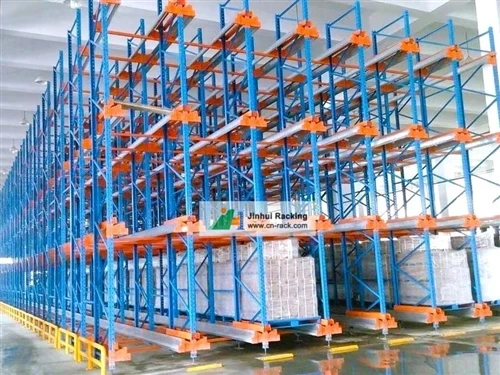

When it comes to optimizing warehouse space and improving material handling efficiency, drive through racking stands out as a popular solution. As a drive through racking supplier, understanding how to measure the performance of this storage system is crucial. This not only helps us provide better products but also enables our customers to make well-informed decisions. In this blog, we will explore various aspects of measuring the performance of drive through racking.
Space Utilization
One of the primary reasons companies opt for drive through racking is its ability to maximize vertical and horizontal space. To measure the space utilization of drive through racking, we first need to calculate the total available storage area in the warehouse. This includes the length, width, and height of the designated area for the racking system.
The total volume of the storage area can be calculated using the formula (V = L\times W\times H), where (L) is the length, (W) is the width, and (H) is the height. Then, we need to determine the volume occupied by the pallets stored in the drive through racking. This can be done by counting the number of pallets, multiplying it by the volume of a single pallet.
The space utilization rate (U) can be calculated as follows: (U=\frac{V_{pallets}}{V_{total}}\times100%)
A high space utilization rate indicates that the drive through racking is effectively using the available warehouse space. For instance, if a warehouse has a total storage volume of 1000 m³ and the pallets stored in the drive through racking occupy 800 m³, the space utilization rate is (80%).
Throughput
Throughput is another critical performance metric for drive through racking. It refers to the number of pallets that can be loaded and unloaded from the racking system within a specific time frame, usually an hour or a day. To measure throughput, we need to record the time taken for each loading and unloading operation.


First, we need to establish a baseline by observing the normal operation for a few days. Count the number of pallets loaded ((N_{load})) and unloaded ((N_{unload})) during a specific period. Then calculate the average throughput ((T)) using the formula (T=\frac{N_{load}+N_{unload}}{t}), where (t) is the total time in hours.
A high throughput rate means that the drive through racking allows for quick movement of goods, which is essential for warehouses with high - volume inventory turnover. However, it's important to note that throughput can be affected by factors such as forklift operator skills, the layout of the warehouse, and the design of the drive through racking itself.
Load Capacity
Load capacity is a fundamental performance measure for any racking system, including drive through racking. It refers to the maximum weight that the racking can safely support. When measuring the load capacity of drive through racking, we need to consider both the static and dynamic loads.
Static load is the weight of the pallets and their contents when they are at rest in the racking. Dynamic load, on the other hand, includes the additional forces generated during loading and unloading operations, such as the impact of forklifts.
To ensure the safety and longevity of the drive through racking, it is crucial to accurately calculate the load capacity. This can be done through engineering calculations based on the design and materials of the racking. For example, if the racking is made of steel, the manufacturer will provide load - capacity charts based on the dimensions and thickness of the steel components. Regular inspections should also be carried out to ensure that the racking is not overloaded.
Durability and Maintenance
The durability of drive through racking is an important aspect of its performance. A durable racking system can withstand the wear and tear of daily operations, reducing the need for frequent repairs and replacements.
One way to measure durability is through the number of loading and unloading cycles the racking can endure before showing signs of significant damage. This can be estimated based on the quality of the materials used, the manufacturing process, and the operating conditions.
Maintenance is also closely related to durability. Regular maintenance can extend the lifespan of the drive through racking. To measure the maintenance performance, we can track the frequency of maintenance activities, the cost of maintenance, and the downtime caused by maintenance. A well - maintained drive through racking system will have a lower frequency of breakdowns and a longer service life.
Environmental Adaptability
In some cases, drive through racking needs to operate in specific environmental conditions, such as cold rooms or processing industrial areas. In such scenarios, environmental adaptability becomes an important performance metric.
For cold rooms, the racking needs to be able to withstand low temperatures without significant reduction in strength or durability. The materials used in the racking should be able to resist corrosion and brittleness at low temperatures. To measure the environmental adaptability in cold rooms, we can conduct tests to evaluate the performance of the racking at different low temperatures over a period of time.
In processing industrial areas, the racking may be exposed to dust, chemicals, or other contaminants. The racking should be designed to resist these elements. We can measure the environmental adaptability in such areas by monitoring the condition of the racking over time and evaluating its resistance to corrosion and other forms of damage.
Compatibility with Warehouse Management Systems (WMS)
In modern warehouses, the compatibility of drive through racking with Warehouse Management Systems (WMS) is becoming increasingly important. A WMS can help optimize inventory management, improve order fulfillment, and enhance overall warehouse efficiency.
To measure the compatibility, we need to assess how well the drive through racking can integrate with the WMS in terms of data transfer, inventory tracking, and operation control. For example, the WMS should be able to accurately locate the position of pallets in the drive through racking, and the racking system should be able to communicate real - time inventory information to the WMS.
We can measure the performance of this compatibility by evaluating the accuracy of inventory data, the speed of order processing, and the reduction of human errors. A high - performance integration with the WMS can lead to significant improvements in warehouse productivity.
As a drive through racking supplier, we are committed to providing high - quality products that meet and exceed our customers' expectations. Our Drive-In / Drive-Through Racking and Warehouse Drive in Pallet Racking System for Cold Room and Processing Industrial are designed with these performance measures in mind.
If you are looking for a reliable drive through racking solution, we invite you to contact us for a detailed consultation and to discuss your specific requirements. Our team of experts will be happy to assist you in choosing the most suitable drive through racking system for your warehouse.
References
- Grant, Paul. "Warehouse Storage Systems: Design, Evaluation, and Performance Metrics". Logistics Publishing Co., 2018.
- Johnson, Linda. "Optimizing Warehouse Space with Drive Through Racking". Industrial Storage Journal, vol. 22, issue 3, 2020.
- Smith, David. "Environmental Considerations for Warehouse Racking Systems". Cold Storage and Processing Review, vol. 15, issue 2, 2019.