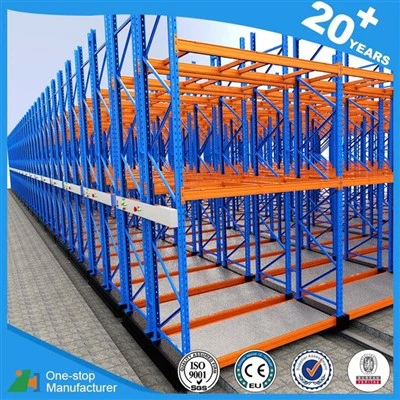

When it comes to optimizing warehouse storage, drive in racking is a popular choice for many businesses. As a drive in racking supplier, I understand the importance of accurately measuring the space required for this type of racking system. In this blog post, I will guide you through the process of measuring the space needed for drive in racking, ensuring that you can make the most of your warehouse space.
Understanding Drive In Racking
Before we dive into the measurement process, let's briefly understand what drive in racking is. Drive in racking is a high - density storage system that allows forklifts to drive directly into the rack structure to store and retrieve pallets. It is ideal for storing large quantities of the same product or SKU. There are two main types: drive - in racking, where the forklift enters and exits from the same side, and drive - through racking, which allows access from both sides. You can learn more about these systems on our website: Drive - In / Drive - Through Racking.
Factors Affecting Space Requirements
Several factors influence the amount of space needed for drive in racking. Understanding these factors is crucial for accurate measurement.
Pallet Dimensions
The size of the pallets you will be storing is the first consideration. Measure the length, width, and height of your pallets. Standard pallet sizes vary, but common ones include 48" x 40" in the United States. Make sure to account for any overhang or irregularities in the pallet dimensions.
Pallet Capacity
Determine the number of pallets you need to store. This will depend on your inventory volume and turnover rate. Consider future growth as well. If you expect your inventory to increase in the coming years, plan for additional pallet storage space.
Forklift Requirements
The type of forklift you will be using is another important factor. Different forklifts have different turning radii and clearance requirements. Measure the width of the forklift, including any attachments, and the turning radius. This will help you determine the aisle width needed for the forklift to maneuver safely within the drive in racking system.
Racking Configuration
The configuration of the drive in racking, such as the number of pallet positions deep and the number of levels, will also impact the space requirements. A deeper rack configuration (more pallets deep) will require less aisle space but more depth in the rack structure.
Step - by - Step Space Measurement
Now that we have covered the influencing factors, let's walk through the step - by - step process of measuring the space for drive in racking.
Step 1: Measure the Warehouse Dimensions
Begin by measuring the length, width, and height of your warehouse. These measurements will provide the overall boundaries for your drive in racking installation. Make sure to account for any columns, walls, or other obstructions that may affect the placement of the racking.
Step 2: Determine the Aisle Width
As mentioned earlier, the aisle width depends on the forklift's turning radius. A general rule of thumb is to allow a minimum of 12 - 15 feet for a counterbalance forklift. However, it's best to consult the forklift manufacturer's specifications for the exact turning radius. Add a few extra feet for safety and maneuverability.
Step 3: Calculate the Rack Dimensions
Based on the pallet dimensions and the number of pallets you want to store, calculate the length and width of the rack structure. For example, if you have a 48 - inch pallet and you want to store 5 pallets deep, the length of the rack will be 48 inches x 5 = 240 inches.
The height of the rack will depend on the height of the pallets and the number of levels. Consider the maximum height limit of your warehouse and the lifting capacity of your forklift.
Step 4: Account for Clearances
Leave some clearance between the rack and the walls, columns, and other equipment. A minimum of 6 - 12 inches of clearance is recommended on all sides. This will allow for easy installation, maintenance, and prevent damage to the racking and the warehouse structure.
Step 5: Consider the Cold Room or Processing Industrial Requirements
If your drive in racking is for a cold room or processing industrial environment, there are additional considerations. For cold rooms, the racking needs to be designed to withstand low temperatures. You can explore our Warehouse Drive in Pallet Racking System for Cold Room and Processing Industrial for more information. Make sure to account for any insulation requirements, temperature - control equipment, and additional safety features in your space measurement.

Example Calculation
Let's assume we have a warehouse with the following dimensions: length = 50 feet, width = 30 feet, and height = 20 feet. We are using 48" x 40" pallets, and our forklift has a turning radius that requires a 13 - foot aisle.
We want to store 5 pallets deep and 3 levels high. The length of the rack for the 5 pallets deep will be 48 inches (4 feet) x 5 = 20 feet. The width of the rack will be based on the number of pallet rows, let's assume 8 rows. So the width of the rack will be 40 inches (3.33 feet) x 8 = 26.64 feet.
The height of the rack for 3 levels of pallets (assuming each pallet with product is 4 feet high) will be 4 feet x 3 = 12 feet.
We need to leave 1 - foot clearance on all sides. So the total space required for the racking will be (20 + 2) feet in length, (26.64+ 2) feet in width, and 12 feet in height. After accounting for the 13 - foot aisle, we can check if the configuration fits within the warehouse dimensions.
Conclusion
Accurately measuring the space required for drive in racking is essential for a successful warehouse storage solution. By considering factors such as pallet dimensions, forklift requirements, and rack configuration, you can ensure that you make the most of your available space.
If you are interested in purchasing drive in racking for your warehouse, whether it's for a cold room, processing industrial area, or a standard warehouse, our team of experts is here to help. We can assist you in the design, measurement, and installation process to ensure that your drive in racking system meets your specific needs. Contact us today to start the conversation and optimize your warehouse storage.
References
- Warehouse storage and handling best practices guides
- Forklift manufacturer's specifications manuals
- Rack design and installation industry standards